Get free quotes from mobile imaging near you
Takes about a minute. Free, no obligation; providers reply to you directly.
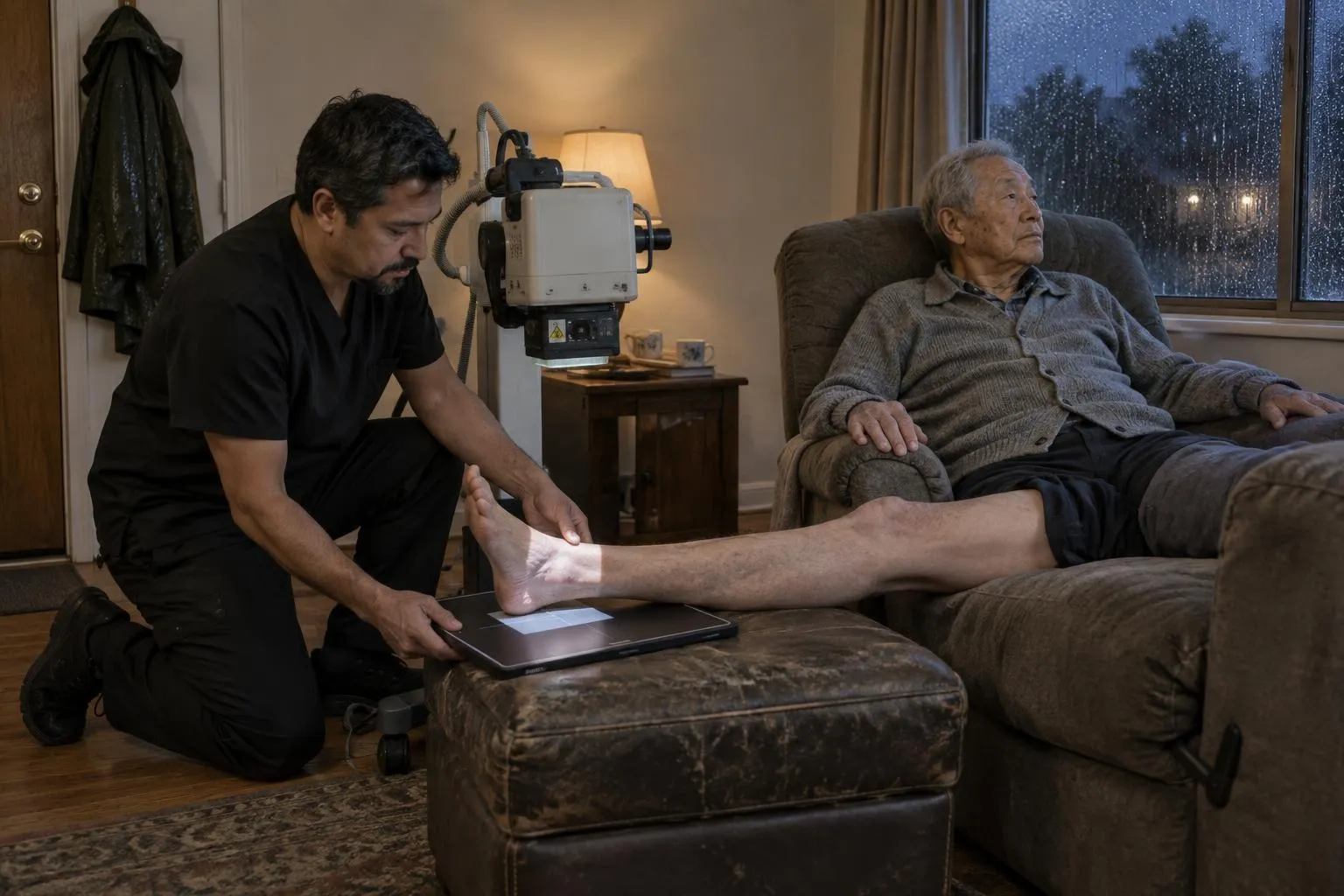
A nursing home director I spoke with described calling three mobile X-ray companies before choosing one based mostly on price. Six months later, a resident’s hairline hip fracture was flagged as “no acute findings” by the interpreting radiologist — who, it turned out, held no board certification and was reading films remotely from a state with no reciprocity agreement. The resident fell again two days later. A real fall, a real fracture, a real lawsuit.
That story is not an outlier. It’s what happens when “mobile X-ray” gets treated as a commodity and credentials get treated as fine print.
The Short Version:Certification matters — a lot — for interpretation accuracy and regulatory compliance. But “certified” means several different things across equipment, technologists, and radiologists, and not all certifications carry equal weight. The right question isn’t whether a provider is certified, it’s which certifications they hold and for what.
Key Takeaways
- Board-certified radiologists produce measurably more accurate diagnoses than non-certified peers, particularly for subtle abnormalities — NIH-linked research supports this directly
- Medicare Conditions of Participation set a baseline floor, but voluntary accreditations (ACR, Joint Commission) signal a provider operating above minimum compliance
- Equipment certification is a separate track from technologist certification — you need to verify both
- For complex or acute cases, a missing credential isn’t a paperwork gap; it’s a clinical risk
What “Certified” Actually Means (Three Separate Things)
Here’s what most people miss: “certified” in mobile imaging doesn’t refer to one thing. It’s a layered term, and a provider can be certified in one dimension while completely uncredentialed in another.
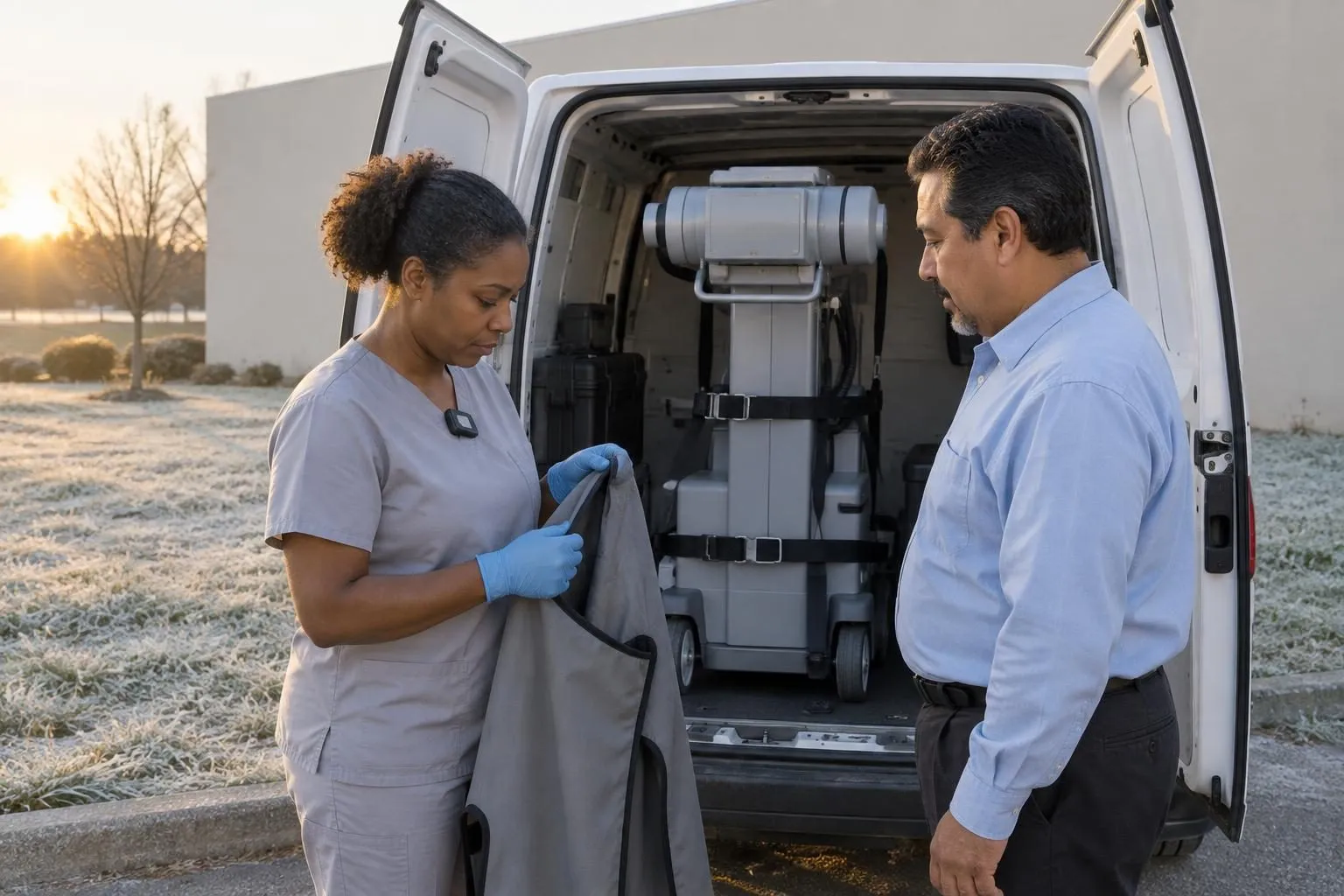
1. Technologist certification — ARRT (American Registry of Radiologic Technologists) licensure is the standard. State law generally requires technologists to hold active credentials and have these verified through diplomas, resumes, or state records. Some states go further with additional portable X-ray operator permits.
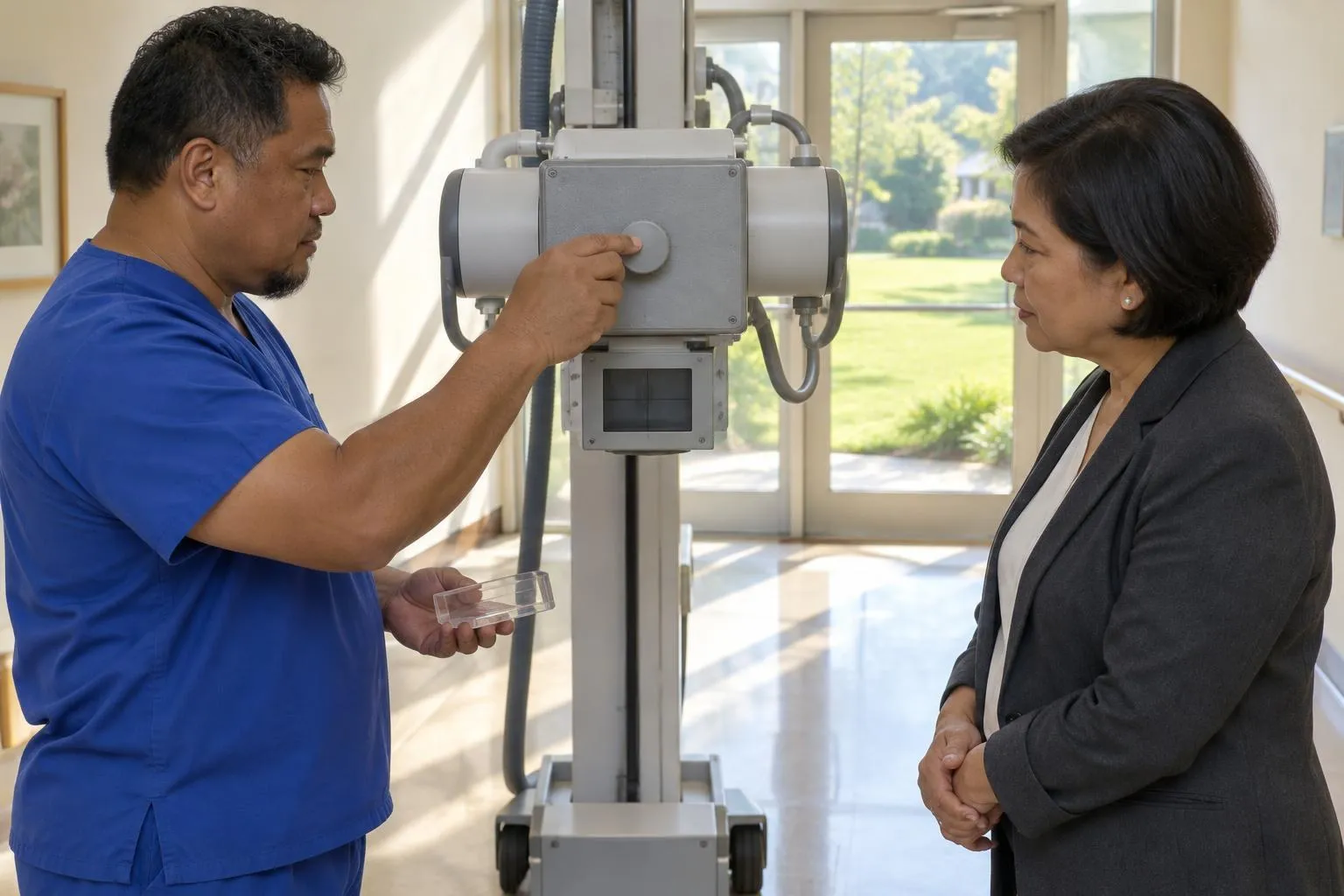
2. Equipment certification — Portable X-ray units require licensing and registration, and maintenance matters enormously. OEM (original equipment manufacturer) service contracts use manufacturer-trained technicians who preserve the unit’s certified status. Third-party repairs using aftermarket parts can quietly void that certification and introduce safety issues that aren’t visible until something goes wrong.
3. Radiologist board certification — This is the layer most administrators underweight. The technologist takes the image; the radiologist interprets it. NIH research is unambiguous: board-certified radiologists achieve higher diagnostic accuracy, especially for subtle abnormalities. That hairline fracture? It’s exactly the kind of finding that separates a trained reader from a credentialed-on-paper one.
The Comparison Table Nobody Shows You
| Dimension | Certified / Compliant Provider | Uncertified / Minimum-Compliance Risk |
|---|---|---|
| Technologist | ARRT-licensed, state-verified credentials | Credentials unverified or lapses undisclosed |
| Equipment maintenance | OEM service contracts, manufacturer-trained techs | Third-party repairs, aftermarket parts, potential certification voids |
| Radiologist interpretation | Board-certified, active licensure in your state | No board certification, out-of-state or unclear credentials |
| Regulatory oversight | Medicare CoP compliant, NRC radiation safety protocols, state inspections | Non-compliance exposure; gaps in HIPAA or radiation shielding protocols |
| Voluntary accreditation | ACR or Joint Commission accredited | Bare-minimum licensure only |
| Diagnostic accuracy | Higher accuracy per NIH-linked data, especially subtle findings | Elevated miss rate for hairline fractures, subtle infiltrates, early pathology |
Reality Check:A provider can be fully Medicare-compliant and still have uncertified radiologists interpreting films. Medicare Conditions of Participation set the floor — they mandate safety, equipment standards, and operational requirements. They do not mandate board-certified reading physicians in every scenario. That gap is where diagnostic risk lives.
When Certification Is Non-Negotiable
There are clinical situations where you simply cannot afford a miss, and in those cases, credentials aren’t a “nice to have.”
Acute presentations. If a resident falls and you’re calling mobile X-ray to rule out fracture before transport, you need a board-certified radiologist reading that film, ideally with stat turnaround. A missed hip fracture, cervical injury, or pneumothorax is not a recoverable error.
Complex chronic patients. Residents on anticoagulants, post-surgical patients, or anyone with osteoporosis present subtle radiographic findings that require experienced, certified eyes. NIH data specifically calls out subtle abnormalities as the category where certification gaps cause the most harm.
Medico-legal exposure cases. Falls, pressure injuries, rapid declines — if there’s any chance an X-ray will end up as evidence, you want an unimpeachable chain of credential documentation.
Pro Tip:Ask every mobile X-ray vendor for the name and NPI of the radiologist who will be reading your films. Then look them up on the American Board of Radiology’s verification tool. Takes 90 seconds. Most administrators never do this.
When Experience Starts to Factor In
I’ll be honest: certification is not a perfect proxy for competence, and experience matters independently.
A radiologist five years out of residency with 10,000 reads under their belt may outperform a freshly board-certified peer in practical accuracy on routine films. For straightforward cases — a standard chest X-ray on a stable resident, a limb film after a minor incident — the credential gap between a solid experienced technologist and a newer certified one may be operationally negligible.
Where this logic breaks down: you often don’t know in advance which cases will be routine. The film you think is a formality is sometimes the one that catches a mass, an infiltrate, or a subtle fracture. You don’t get to choose which cases are “routine” after the fact.
The smarter frame isn’t “experience vs. certification.” It’s: certified AND experienced is the standard, and any provider asking you to accept less should explain specifically why.
The Staffing Reality (And What It Costs)
Mobile X-ray providers face genuine staffing shortages for certified technologists. That’s real, and it drives some quality cutting. Providers that staff with verified, contracted technologists — rather than running lean on whoever’s available — typically pass that cost along. Full-service contracts covering licensing, accreditation, equipment, personnel, and consumables cost more than bare-bones providers. That cost differential is doing real work.
If a mobile imaging provider is dramatically cheaper than their competitors, the useful question is: where did the margin come from?
Practical Bottom Line
For SNF administrators and home health directors contracting mobile imaging services, here’s the verification checklist that actually matters:
- Ask for technologist credentials by name — ARRT number and state license. Verify both.
- Ask who reads your films — Name, NPI, board certification status, state licensure. Confirm via ABR verification tool.
- Ask about equipment maintenance contracts — OEM service agreements vs. third-party. Get this in writing.
- Ask about accreditation — ACR or Joint Commission accreditation signals a provider that audits itself above Medicare minimums.
- Trust stat response commitments only if they’re contractual — “We turn around results fast” and “We guarantee stat reads within 2 hours” are different statements.
The providers who push back on this checklist are telling you something.
For more on how to evaluate the full scope of mobile imaging services, see the Complete Guide to Mobile X-Ray Services. Certification is one lens — the full picture includes equipment types, turnaround benchmarks, and how providers handle acute versus routine workflows.
Done reading? Get quotes from mobile X-ray services near you.
Takes about a minute. Free, no obligation; providers reply to you directly.
Popular cities:
Nick built this directory to help SNF administrators and home health agencies find credentialed mobile imaging providers without wading through services that lack proper ARRT licensure or ACR accreditation — compliance gaps he uncovered when researching portable imaging options for a family member in long-term care.